




A driver glances at a text, looks up too late, and slams into the back of your car on I-285. Or you’re stopped at a red light on Peachtree when someone scrolling Instagram drifts into your lane. Distracted driving accidents happen in seconds, but the decisions you make in the minutes and days that follow shape everything that comes next, including your medical recovery, your insurance claim, and in any case that a distracted driving accident lawyer might build on your behalf.
What separates a distracted driving crash from an ordinary collision is proof. The other driver’s negligence happened on a phone screen, behind the wheel, before you ever saw them coming. The evidence that proves it disappears quickly. Phone records get overwritten, witnesses leave, dashcam footage loops, and memories fade. Knowing what to do, and what not to do, protects your health, your rights, and your ability to recover compensation under Georgia law.
Key Takeaways
- Call 911 immediately, request a police report, and tell the responding officer everything you observed about the other driver’s behavior before impact.
- Georgia’s Hands-Free Law (HB 673) makes most phone-in-hand use illegal while driving, and a citation against the other driver strengthens your liability case.
- Photograph the scene, identify witnesses, and note any phone visible in the other driver’s hand or lap before evidence is moved or removed.
- See a doctor within 24 to 72 hours, even if you feel fine at the scene, to connect any injuries to the crash.
- Do not give a recorded statement to the other driver’s insurance company or accept an early settlement offer before speaking with an attorney.
- Georgia’s modified comparative negligence rule bars recovery if you are found 50% or more at fault, so evidence preservation is critical.
Immediate Steps to Take at the Scene of a Distracted Driving Crash
Your first priority is safety. Check yourself and any passengers for injuries, then move your vehicle out of traffic if it is drivable and the damage is minor. Georgia’s “Steer It, Clear It” guidance encourages drivers to clear minor crashes from active travel lanes to prevent secondary collisions, which are especially common on I-75, I-85, and I-285. If your car cannot move or anyone is seriously hurt, leave the vehicle in place and get yourself to a safe spot behind a guardrail or off the shoulder.
Call 911. Under O.C.G.A. § 40-6-273, Georgia drivers must report any crash involving injury, death, or apparent property damage of $500 or more, and a police report is one of the most valuable pieces of evidence in any injury claim. Tell the dispatcher your location using mile markers, exit numbers, or visible landmarks, and request both law enforcement and emergency medical services if anyone may be hurt.
When the officer arrives, describe exactly what you saw. If the other driver was holding a phone, looking down, weaving, or failed to brake before impact, say so. Do not speculate, do not apologize, and do not admit any responsibility, even casually. Georgia follows a modified comparative negligence rule, and offhand statements at the scene often resurface later as evidence against you. Exchange driver’s license, registration, and insurance information with the other driver, but keep the conversation factual and brief.
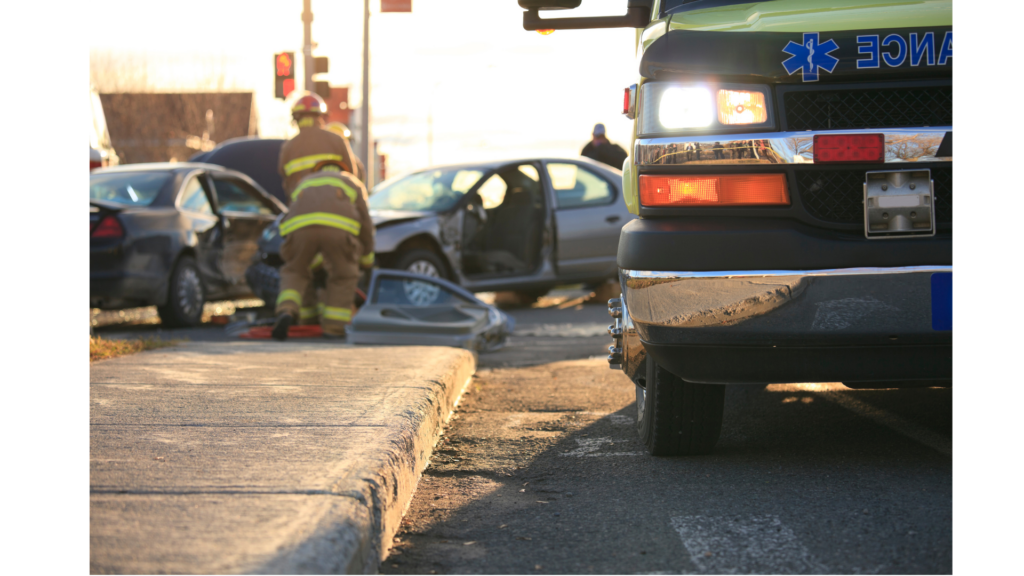
How to Document Evidence That Proves Distracted Driving
A distracted driver accident is harder to prove than other crashes because the negligence happens inside the vehicle. The other driver will rarely admit they were texting, scrolling, or watching a video. Building a case starts at the scene, while the evidence still exists.
- Take photographs of everything: vehicle damage from multiple angles, the position of both cars before they are moved, skid marks (or the absence of them, which often suggests no braking), debris patterns, traffic signals, and any phone you can see inside the other driver’s vehicle. If a phone is visible on the dashboard, in the cupholder, or on the seat, photograph it. Capture the surrounding area too, including nearby businesses or intersections that might have surveillance cameras.
- Identify witnesses immediately. Drivers in adjacent lanes, pedestrians, and bystanders often saw the other driver looking down or holding a phone before the crash. Get their names and phone numbers before they leave the scene. A witness who can testify they saw the at-fault driver staring at a screen seconds before impact is powerful evidence, and these accounts are difficult or impossible to recover days later.
- Note any dashcam in your vehicle, the other driver’s vehicle, or nearby cars. Save your own footage immediately. Many dashcams record on a loop and overwrite older footage within hours. If a rideshare or commercial vehicle was nearby, their cameras may have captured the incident.
- Look for traffic and surveillance cameras in the area. Intersections, gas stations, ATMs, and storefronts often have footage that can be preserved if requested quickly, often through a preservation letter sent by your attorney within days of the crash. The same applies to the other driver’s phone records, which can be subpoenaed during litigation to show whether a call, text, or app was active at the moment of impact.
Georgia’s Hands-Free Law and Why It Matters for Your Claim
Georgia’s Hands-Free Law, enacted as House Bill 673 and codified at O.C.G.A. § 40-6-241, took effect on July 1, 2018. The statute prohibits drivers from holding or supporting a phone or any electronic device with any part of their body while operating a vehicle. It also bans writing, sending, or reading texts, emails, or social media content; watching videos; and recording videos behind the wheel.
The law allows hands-free use through speakerphone, earpieces, smartwatches, and dashboard-mounted devices, but actually touching the phone is a violation unless the driver is lawfully parked or reporting an emergency. First-time violators face a $50 fine and one point on their license, with steeper penalties for subsequent offenses.
For an injury claim, a citation under the Hands-Free Law is a substantial piece of evidence. It establishes that the at-fault driver violated a specific statute designed to prevent the exact type of crash that occurred. Georgia courts recognize the doctrine of negligence per se, which means that violating a safety statute can serve as automatic proof of negligence when the violation causes the type of harm the statute was meant to prevent. Even when no citation is issued, the law sets a clear standard of conduct, and any evidence the other driver violated it strengthens the case. Understanding how fault is determined in a Georgia car accident is critical, because the more clearly negligence can be shown, the stronger your position becomes in settlement negotiations or at trial.
Medical Care and Why Delays Hurt Your Case
Get medical attention within 24 to 72 hours of the crash, even if you feel uninjured at the scene. Adrenaline often masks pain in the hours following an accident, and injuries like whiplash, concussions, soft tissue damage, and internal bleeding may not produce symptoms until the next day or later. A delay in treatment creates two problems: it puts your health at risk, and it gives insurance adjusters an argument that your injuries were not caused by the crash.
Follow every recommendation your provider makes. Attend follow-up appointments, complete physical therapy, fill prescriptions, and document symptoms in writing as they develop. Insurance companies routinely scrutinize medical records for gaps in treatment and use any delay as evidence that an injury healed, was minor, or stemmed from something other than the accident. Consistent medical documentation creates the objective record that ties your injuries directly to the distracted driver’s conduct.
Keep copies of every bill, diagnosis, imaging report, and discharge summary. These records support claims for medical expenses, lost wages from missed work, and noneconomic damages like pain and suffering damages under Georgia law.
Dealing With Insurance Companies After a Distracted Driving Accident
You will likely hear from the at-fault driver’s insurance company within days, sometimes hours, of the crash. The adjuster will sound friendly, ask casual questions, and request a recorded statement. Decline politely. You are not legally required to give a recorded statement to the other driver’s insurer, and anything you say can be used to minimize or deny your claim later.
Be cautious with your own insurer as well. You have a duty to report the crash and cooperate with your policy’s terms, but you can ask for questions in writing and review them with an attorney before responding. Never speculate about fault, downplay injuries, or estimate damages before you know the full extent of your medical treatment.
Early settlement offers are another tactic. Insurance companies frequently offer quick, low payments before injured drivers understand the long-term costs of their injuries. Accepting an early offer typically requires signing a release that permanently closes your claim, even if you need additional treatment, surgery, or therapy months down the road.
Georgia’s modified comparative negligence rule, set out in O.C.G.A. § 51-12-33, reduces or eliminates recovery based on the injured party’s share of fault. If you are found 50% or more responsible, you cannot recover at all. Insurance companies know this and routinely try to shift blame, even in clear distracted driving cases. Familiarity with Georgia’s comparative negligence law helps explain why preserving evidence and avoiding unguarded statements matters so much.

Compensation You May Be Entitled To After a Distracted Driving Accident
A successful claim against a distracted driver can recover several categories of damages under Georgia law. Economic damages cover measurable financial losses: emergency room and hospital bills, ongoing medical treatment, future care, lost wages, reduced earning capacity, vehicle repair or replacement, and out-of-pocket expenses related to the injury. Noneconomic damages compensate for pain, emotional distress, loss of enjoyment of life, and diminished quality of relationships, which are real but harder to quantify. In cases involving especially egregious conduct, such as a driver who was watching a video or live-streaming behind the wheel, punitive damages may also be available to punish the conduct and deter similar behavior. The actual value of any claim depends on the severity of injuries, the available insurance coverage, the strength of evidence, and how the case is presented. A clear understanding of filing a personal injury claim gives injured drivers a realistic view of the process and the timeline ahead.
How a Distracted Driving Accident Lawyer Strengthens Your Case
The evidence that proves distraction often requires legal authority to obtain. Cell phone records showing calls, texts, app activity, and screen taps at the moment of impact can be subpoenaed during litigation but are generally not accessible to private individuals. Vehicle telematics, infotainment system logs, and event data recorder (“black box”) data can reveal whether the driver was braking, accelerating, or maintaining steady speed in the seconds before impact, all of which speak to attention.
Experienced car accident attorneys also work with accident reconstruction specialists, medical experts, and human factors analysts who can demonstrate how distraction caused the specific collision and how the injuries map to the impact. They preserve evidence quickly through spoliation letters, file insurance claims correctly, handle communication with adjusters, and prepare cases for trial when a fair settlement is not offered. Insurance companies routinely offer significantly different settlements depending on whether the injured driver has representation, in part because represented claims are prepared in ways that signal trial readiness.
Frequently Asked Questions
How long do I have to file a distracted driving accident claim in Georgia?
Georgia’s statute of limitations for personal injury claims is generally two years from the date of the accident under O.C.G.A. § 9-3-33. Property damage claims have a four-year window. Waiting close to the deadline limits investigation time and weakens claims, so earlier is always better.
What if the police did not cite the other driver for distracted driving?
A citation is helpful but not required. Distraction can still be proven through witness testimony, phone records obtained during litigation, dashcam footage, surveillance video, vehicle data, and the physical evidence at the scene. The absence of a citation does not eliminate the claim.
Can I still recover compensation if I was partially at fault?
Yes, as long as you are less than 50% at fault. Georgia’s modified comparative negligence rule reduces your recovery by your percentage of responsibility. At 50% or higher, recovery is barred entirely, which is why fighting fault allocation is critical in distracted driving cases.
What if the distracted driver was working at the time of the crash?
If the at-fault driver was performing job duties, was on a work call, or was driving a company vehicle, the employer may share liability under the doctrine of respondeat superior. Commercial policies typically carry higher limits, which can affect the available compensation.
Should I post about the accident on social media?
No. Insurance companies and defense lawyers monitor social media accounts, and photos, status updates, or check-ins can be used to dispute the severity of injuries or shift fault. Set accounts to private and avoid posting anything related to the crash until your case resolves.
What if the at-fault driver does not have enough insurance?
You may be able to recover through your own uninsured or underinsured motorist coverage if you carry it. Some claims also involve multiple potentially liable parties, such as employers, vehicle owners, or commercial entities, which can expand the sources of recovery.
Contact Us After a Distracted Driving Accident in Atlanta
If you were hit by a distracted driver in Atlanta, Marietta, Decatur, Sandy Springs, Macon, or anywhere in Georgia, the steps you take now affect the outcome of your case. Call Cambre & Associates Injury & Accident Lawyers at (770) 502-6116 or contact us to discuss what happened and what to do next. Acting early gives your case the best chance of preserving evidence, identifying witnesses, and securing the records that prove the other driver was not paying attention.
About Cambre & Associates Injury & Accident Lawyers
Cambre & Associates Injury & Accident Lawyers is a Georgia personal injury firm representing people hurt by negligent drivers across the Atlanta metro area and the rest of the state. Our attorneys handle distracted driving cases, rideshare crashes, truck collisions, and a full range of motor vehicle injury claims, with a focus on building thorough, evidence-driven cases. We work with accident reconstruction specialists, medical experts, and investigators to recover the records and testimony needed to hold distracted drivers accountable.